Showing posts with label hell. Show all posts

2011-05-29

Positive & Negative Conceptions of God

Although I’ve always known that most believers sincerely love God or at least have very positive feelings toward him, I’ve recently come to realize how much I’ve failed to appreciate this fact when dealing with others, and I suspect my own feelings about God have clouded my perceptions. That is to say, I think my negative view has prevented me from understanding how precious their beliefs are to them, and I would do well to remind myself that most people don’t share my opinion, no matter how justified I think it is.

While I was certainly a devout believer before my deconversion, I can’t say that I ever really loved God. As a child, I was completely uninterested in religion, and when I became interested as a teenager, it was primarily because I was worried about avoiding hell. I didn’t care nearly as much about serving God for his own sake, bringing him glory, building a relationship with him, or even entering heaven when I died. From the beginning, my view of God was heavily influenced by my fear of eternal damnation, and this fear intensified during my struggle with scrupulosity, eventually transforming into frustration, anger, and even hatred during my last few months as a believer. Most Christians love God for creating them, blessing them, and “saving” them from hell; I, on the other hand, could never bring myself—no matter how hard I tried—to love a being who threatened to burn me in a lake of fire if I didn’t meet his demands, especially his demands that I completely repress my sexuality and suppress my doubts. For this reason, though my deconversion itself was emotionally draining, I emerged from the experience happier than ever. I didn’t feel like I had lost anything except my unfounded fears. It sounds strange for someone who built his entire worldview and identity around religion to say, but my belief in God was simply never important to my happiness; it was instead mainly a source of worry and anxiety. Sure, the prospect of living forever in paradise and the promise of having one’s viewpoint vindicated to all humankind after death were certainly nice consolations, but they never came anywhere close to negating the misery of having hellfire constantly hanging over my head. Once I stopping believing in God, I was happy the divine blackmailer was gone, and I didn’t want to see him ever return.

Now when I deal with believers, I frequently forget how their view of God radically differs from my own. If I present arguments against their religion, they’re generally unreceptive because they want God to exist. They’re not going to consider the possibility that they’re mistaken unless they absolutely have to. Their faith is a source of hope and joy for them rather than a source of fear and sorrow, as it was for me. God is often the most important person in their life, as it were. To those who sincerely love God and especially those who have never even seriously contemplated the possibility that he doesn’t exist, merely expressing my atheistic viewpoint is akin to suggesting that the parents who raised them were actually paid actors who never really loved them, as in The Truman Show. It’s no wonder they react so negatively toward atheists, especially atheists who directly challenge their beliefs and sometimes even insult their beloved heavenly father. Followers of other religions may worship other gods, but none of them really explicitly deny that the Abrahamic god exists and thus deny the validity of their special relationship with him. This is why the highest level of contempt from believers is reserved for atheists. Of course, it doesn't at all excuse their mistreatment of us atheists, but it does help us understand it.

This is not at all a new insight, but it’s especially important for me in particular to bear in mind when thinking about or discussing religion. It’s so easy for me to forget that very few people, even other atheists, have such negative emotional reactions to the mere mention of God. Not only does it bring to mind irrational belief without evidence, it conjures an image of the deity who killed Egyptian babies, who ordered the genocide of the Canaanites, who damns billions of unbelievers to hell, and especially who made my life such misery for so many years. Whereas some nontheists are attracted to deism or pantheism as a way to salvage belief in God when their traditional conception is dismantled, I want nothing to do with the idea at all. Instead of an emotional attachment to it from past positive experiences, I have an aversion due to my past negative experiences. I think it’s noteworthy, however, that this aversion doesn’t extend to every aspect of religion. In fact, I’m sometimes drawn to the idea of a humanistic and potentially naturalistic religion like Unitarian Universalism. I rather like the idea of frequent, regular meetings of a community united in their values, if not beliefs, to discuss ethical, social, and personal issues and enjoy each other’s friendship. I know that if I ever wanted to join such a community, I would need to overcome my distaste for the idea of God, at least as a metaphor, and appreciate that it means so much to so many people because they conceive of it so differently.

Even if I never join such a community, it’s still a good idea for me to attempt to rid myself of such emotional baggage, for my own sake and for the sake of understanding others. I stopped believing in God years ago, and now it’s time for me to stop loathing the idea of God itself, by disassociating it from the idea of hell, which I will always rightly hate. Perhaps I can approximate the mental state of most believers by imagining a universalist god who never even considered creating hell and who will welcome absolutely everyone into heaven. Such a deity would still be vulnerable to criticism from the Problem of Evil, but it's so much easier for me to have less negative feelings about this concept. It's an interesting mental exercise, and I hope it will help me improve my interactions with believers.

Image: Evgeni Dinev | FreeDigitalPhotos.net

Share/Save/Bookmark

2011-04-22

An Evil Deity Cannot Be Trusted

While there are many well known objections to Pascal’s Wager, in a recent e-mail discussion with a reader I formulated a simple argument which I don’t remember ever having encountered and which I would like to share here: A deity who causes any of its creatures to suffer eternal torment is necessarily evil, and thus we cannot trust such a deity to honor its promises regarding salvation. Therefore, we have no reason to believe that practicing any religion in order to enter its heaven and avoid its hell will be more successful than not practicing it. It’s better to practice virtue as informed by our reason and not worry about unsubstantiated threats from unknown gods.

Image: Grant Cochrane | FreeDigitalPhotos.net

Share/Save/Bookmark

2010-12-09

Go to Mass or Go to Hell

The Catholic Church teaches that its members must attend mass on Sundays and all other holy days of obligation under pain of mortal sin. This means that if they purposely miss mass, they commit a mortal sin and, as with all mortal sins, if they then fail to repent of and confess this before they die, God will condemn them to hell for all eternity. If you choose to sleep in, to stay home and read a book, to have a picnic with your family in the park, to do anything but sit, stand, kneel and—most important—hand over your money in church for an hour each week, then you risk frying in a lake of fire for your grievous transgression. While I understand the pragmatic benefits the Catholic Church reaps from people who still take this threat seriously and begrudgingly shuffle off to mass each week when they would otherwise actually enjoy their alleged day of rest to the fullest, it makes little sense from a theological perspective.

Why would God threaten believers with punishment for failure to attend mass? The most plausible justification, at least initially, is that he wants to encourage them to attend, in the same way that a parent punishes a child who skips school. The problem is that God inflicts a punishment identical to the harm to be avoided in the first place! We can presume that God wants believers to attend mass with the ultimate goal of saving their souls from damnation; the danger in not attending mass regularly is that one may stop believing and/or commit acts which are inherently wrong such as murder, theft or adultery and end up in hell. But threatening believers with the potential danger is absurd, as it unnecessarily increases the danger which believers face, giving them an easier and more certain avenue to hell. (Of course, hell itself is already infinitely unjust. Of course, God himself created the original danger. I’m just showing how it’s absurdity upon absurdity.) It would be as though the state executed drivers who failed to use their seat belts. That’ll show them to be more careful next time! Never mind that there’s no next time, either for the executed or the damned, and that they would have been perfectly fine without either punishment.

Of course, if God has purely selfish motives for demanding his believers worship him every week, we might have a different analysis. One might think that God, for every person he tosses into the everlasting flames, loses an infinity of worship from this person, but St. Thomas Aquinas argued the saved in heaven will delight in the suffering of the damned, so perhaps God’s interests are served no matter what. Then why go the whole charade of earthly existence? I would say that perhaps the drama is interesting, but God already knows how it’s going to end anyway. What’s the point of playing it out? It’s impossible to avoid absurd conclusions when one postulates an infinite being, and throwing in infinite rewards and infinite punishments doesn’t help. My intention here was just to point out one additional absurdity peculiar to Catholicism.

Share/Save/Bookmark

2010-10-06

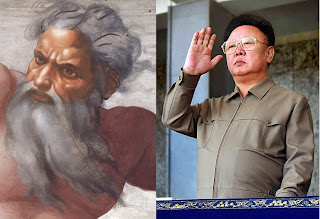
God is Worse than Kim Jong-il

In my international human rights course, we've spent a lot of time discussing North Korea, both because it presents the most egregious examples of current human rights violations and because our professor has a special research interest in the topic, his family having fled Korea during the war and he having also taught in South Korea. The professor recently recounted a familiar story about foreign doctors entering the country, curing people of their ailments, and the healed immediately thanking and praising the dear leader before his portrait for helping them and curing them, despite his totalitarian and ruthless regime most likely being the direct cause of their suffering in the first place. Everyone in the class rightly considered the situation ridiculous and sad. My mind, both then and when I first heard the story years ago, immediately made the comparison between how many people in other countries would have turned to their gods in exactly the same way after the medical treatment and how it's equally ridiculous and sad.

I honestly believe that an omnimax deity who fails to help his creatures and who sends any of them to hell would be infinitely more evil than Kim Jong-il. Even leaving aside the eternity of hell which really trumps everything else, God could distribute food and medicine to the populace without any effort whatsoever whereas the North Korean government at least has to arrange to let humanitarian relief organizations enter the country to do the same. Indeed, God could miraculously heal everyone of every lament, but he never does. All the excuses that theists make on God's behalf could be equally well applied to Kim Jong-il—he knows better than we do, it's for the greater good, we have to trust in him despite all appearances. It was depressing to see documentary footage in class of North Koreans escaping into China and constantly talking about how they trusted in God to help them. It's very understandable under the circumstances of extreme hardship, extreme ignorance, and extreme fear, but it's still disheartening to see them exchange a real dictator for an even worse fictional one, one who ultimately let them down when they were captured and returned to North Korea to be imprisoned in death camps.

The only point that God has in his favor is that he doesn't actually exist. This certainly excuses his failure to help people. It also means he cannot inflict any of the suffering which he allegedly threatens; only people's belief in him can, and that level of suffering is relatively minor, especially in nations which don't take religion especially seriously. My experience with scrupulosity, while the most serious suffering of my life, is nothing compared to starvation, imprisonment, and torture. Life—or more accurately existence—in North Korea, however, would in turn be nothing compared to eternal hell, if it were real.

I'm sure that many theists feel revulsion at the comparison of the God to Kim Jong-il, but they've never provided adequate responses to the Problem of Evil or to the Problem of Hell, so I feel entirely justified in making it. This is why I blog: to say things that simply need to be said.

Share/Save/Bookmark

2009-12-14

Comforting Others in Pain

In the face of suffering, believers almost have always something they can say to others: they can say, first, that they're praying for them, and, second, that everything will be alright in the end. Nonbelievers can't honestly say either of these. The closest we can get is that we're thinking about them, which can raise their spirits but not give them hope it'll actually help their problem, and that their suffering will eventually end at death, which really only helps those with terminal conditions and those afraid of hell. There's really not much you can say in the face of harsh reality that doesn't involve asking them to toughen up and accept their plight.

I've been thinking about this recently because I have a classmate who's suffered both a divorce and a diagnosis of cancer within the past half year. (What's worse for him is that his ex-wife is now with another classmate of ours.) He's really nice, honest and hardworking, and I like and respect him. On Facebook, his status updates about his treatment and various difficulties always receive many comments about people praying for him and promising him that it'll be alright in the end. I honestly add that we've missed him and hope to see him again soon, and I do hope all the comments make him feel better, but my inability to say anything more just got me thinking on this topic.

Sometimes I think it'd easier if I again believed that everything will eventually be perfect in the afterlife, but I'd probably again fear the prospect of eternal torment for failure to live a good enough life. If I had a choice between somehow honestly believing that life will never end but that there was even the tiniest chance I would end up in hell, and believing that my life will end forever at death, then I would certainly choose the latter. I'd sacrifice a very, very high probability of eternal pleasure to avoid even a very, very low chance of eternal pain. Of course we can't honestly choose our beliefs, and even seemingly perfectly innocent self-deception can have unpredictable negative consequences, if not for me, then for others. I hope that I can remain as intellectually honest throughout my life as I resolve to be today.

Share/Save/Bookmark

2009-07-11

Uncertainty about the Afterlife

In response to the problem of evil, believers typically claim that God must have a perfectly valid reason for allowing great evil in the world even if we cannot discover or understand it and that the proper response is to trust him without questioning. I recently encountered an interesting idea from Robert M. Price which addresses this response in a new way. He rhetorically asks how Christians would react if, upon death, God canceled their ticket to heaven (faith in Jesus, life of good works, state of grace at death, etc.) and sent them to hell without any explanation whatsoever. Applying their argument to this situation, they couldn't complain at all, for God must have a perfectly valid reason for sending them to hell even if they cannot discover or understand it. No Christian could honestly counter that it's an absolute impossibility; this is the same deity who slaughtered multitudes of Egyptian babies in their sleep and who they acknowledge threatens to send billions of souls to hell for mere disbelief. It's a perfectly valid rhetorical question without any clear answer.

Dr. Price's idea reminds me of the major issues I had with scrupulosity and fear of hell before I deconverted. For years, I had regular, persistent doubts about whether my confessions were valid, whether I was forgiven, and whether I would be damned to hell if I died at that moment. Priests regularly told me to trust in God's love and that God wouldn't condemn me if I honestly did my best to obey him, but their assurances never helped me because I also believed this was a deity who didn't hesitate to send souls to hell for all eternity for something as absolutely ridiculous as masturbating or missing mass one Sunday; I had no trouble imagining him on judgment day telling me that I sinned by listening to my confessor instead of my own conscience and casting me into a lake of fire to burn forever. It was mental agony to believe one is constantly being watched by a despicable, malevolent being who demands blind love, blind faith, and blind obedience and who will probably eventually capture and torture you. It's a lot like being Winston Smith in Nineteen Eighty-Four, but with infinite consequences. This is why the day I deconverted was the best day of my entire life.

While I'm on the topic of the afterlife, I want to say that sometimes I rather wish there were a way for arrogant religionists who claim certainty in their beliefs to learn they're wrong before they die. If my belief is correct that our consciousness is forever extinguished upon death, it's really a pity they can all pass out of existence without ever being forced to admit the magnitude of their stupidity.

Share/Save/Bookmark

2009-04-09

Worshiping a Monster

Yesterday there was an entry at Daylight Atheism on the subject of the atrocity of Passover. One of the comments suggested modern Jews recognize the suffering entailed in the divine slaughter of the first-born Egyptians and mourn for the dead. This seems something like moral progress, but the fact remains they still worship a deity who alleged killed thousands upon thousands of innocent children! There's not even the tiniest sliver of justification for it. At Passover, Jews thus thank a mass murderer for sparing them and praise him for his moral perfection. In the same entry, there were other comments about the importance of the symbolism of the story, but even as an allegory, it fails miserably to communicate any worthwhile or respectable message.

Christians hold an even worse moral position. Although they don't celebrate Passover, they revere the same vile story. What's worse is that they believe this monster tortures unrepentant sinners in a lake of fire for all of eternity, making him infinitely more evil and despicable, all the while constantly extolling his love and mercy. It could hardly be any more absurd.

Share/Save/Bookmark

2009-03-18

Nothing to Fear

This opinion column by Terry Dickson was published in the life section under the title, “Righteous ‘fear’ has its place.” I found most of it unremarkable except for a few choice selections.

The slide in religious affiliation [in New England] may be because of a lack of fear.
Perhaps this is correct. Maybe more people are increasingly realizing they have nothing to fear from non-existent deities and their imaginary torture chambers.
I like what the Rev. Tommy Nelson, senior pastor at Denton Bible Church in Denton, Texas, sometimes says. He'll be reading along in the Bible and do a little interpretation. “In the original Greek,” he'll say, “the word fear means fear. Be afraid.”
I suppose he didn't get the memo from liberal theologians and apologists that Christianity is supposed to be a religion of love and peace, and he actually read Jesus' intolerant and exclusivist message in the bible!
“I'm prophesying we'll become more religious with this economic downturn,” [Rev. Jay Hanson] said. FDR famously said during the Great Depression, “The only thing we have to fear is fear itself.”
How utterly ironic! Dickson laments modern society's lack of fear of God throughout the entire column and then at the end suggests with this quotation that we have nothing to fear and should not be afraid of anything except irrational fear! Be not afraid, indeed!

Share/Save/Bookmark

2009-02-18

Foolish Wager

I love waking up in the morning and being threatened with hell as I eat breakfast. This letter by Joyce Bates was published today under the heading, “Atheism: Price of being wrong.”

I am mystified by the belligerence of atheists. Do they really believe their "sincerity" is more important than truth? I'm not trying to persuade them, I just want them to stop trying to persuade me. Why does my belief bother them so much? If I'm wrong, I lose nothing and gain everything. If they're wrong, they lose everything and gain nothing. Looks like a no-brainer to me.
First, I don't know which alleged belligerence she's referring to. She really needed to be more specific. Second, I've never heard any atheist claim that sincerity is more important than truth. Third, I have no idea how atheists are trying to persuade her. We don't have churches, schools, universities, television channels, or radio stations. There are a few local television and radio shows around the country and some podcasts, but those are almost never about deconverting theists. There are atheist books and bookstores, but nothing compared to the number of Christian books and bookstores. I've heard of atheist street preachers and tracts online, but I've never encountered them in person and I would bet neither has the author. I've never even heard of a door-to-door proselytizer. Fourth, her belief bothers some of us because it's irrational and dangerous. It adversely affects political and social life. Fifth, if she actually thinks Pascal's wager is a valid argument for belief, then “no-brainer” a very apt description of her. She claims not to want to persuade us and then she threatens us with eternal torture. This is why religion is evil.

Share/Save/Bookmark

2008-12-14

My Mother Thinks I'm Going to Hell

Since my deconversion over four years ago, my Catholic family has never given me any trouble about my atheism. Outside of one occasion a long time ago during which my mother asked me a few simple, polite questions about what I believe now, they never even raise the topic of religion with me. They do talk about church activities around me, but it has nothing to do with my presence. They also pray before meals, but they've done that forever and I've never considered objecting, especially since it's quick and they're giving me free food! They never give me any flack whatsoever and never treat me any differently than they ever have, so the following episode surprised and hurt me.

A few weeks ago, my mother told me a story about my niece. My older sister regularly babysits two children of her neighbors who happen to be Buddhist. One day one of the neighbor kids heard something about Jesus and asked, "Who's Jesus?" My four-year-old niece told her, "You'd better know who Jesus is or you're not going to heaven!" My mother told me this story somehow thinking I would be amused, but I didn't laugh at all. I struggled to tell her I found it disturbing a little child has been taught to divide the world up into us versus them and tell people they're going to hell. She didn't seem to understand my viewpoint as she just thought it was funny a child would say something so adult-like. We talked and my mother expressed the (heretical from a Catholic perspective) opinion that it doesn't matter what religion you believed since they all lead to God. I asked her about the rest of the people and reminded her about me. She didn't say anything at first and said my beliefs are my own business.

So in the end, my mother who loves me very much and would do absolutely anything for me thinks I'll be damned to hell by her god who is supposedly all-loving for simply disbelieving in extraordinary claims without any evidence. In her view, it apparently doesn't matter what religious belief you have or why you believe it, you're still better than someone who looks at religion critically and decides it's simply not true. The dissonance between her belief and actions is remarkable. I thought about writing her a letter to express my thoughts, but I haven't done so. I see no need to risk adversely affecting our relationship over this evil belief which she doesn't talk about or act upon. It just bothers me that my family could possibly think I truly deserve to be roasted alive for all eternity. It makes me even more grateful for my new godfree wife whose love for me isn't obscured by systematic irrationality.

Share/Save/Bookmark

2008-12-06

Levels of Control: Christianity vs. Atheism

I recently removed the Obama bumper sticker from the back of my car since the election is over and I decided that I don't want to give people controlling very heavy equipment at very high speeds an extra reason to feel any antagonism toward me on top of their general disdain for humanity. Despite this, earlier today I was pondering what the theoretical reaction might be to a sticker which read, “Smile! There is no hell!” I think the response would be less negative than to most anti-theistic messages, but I'm sure some people would think it's an evil lie intended to deceive people and lead them into hell although its actual purpose is quite the opposite: to help people free themselves from the control of manipulative institutions teaching an evil untruth! This led me to ponder the stark contrast between religion and irreligion with respect to control, and I've complied a short list of differences between Christianity and atheism on this matter:

Christianity

  • We demand ten percent of your money.
  • We demand at least one hour per week of your time.
  • We demand total allegiance.
  • Don't think for yourself.
  • Obey all of our rules, even if they're absurd or evil.
  • Only vote for candidates of whom we approve.
  • If you disagree with us, you will be roasted in the flames of hell for all eternity.
  • People on the other side are either knowing or unknowing agents of the devil.
Atheism
  • We don't want your money.
  • We don't want your time.
  • We don't want your allegiance.
  • Think for yourself.
  • Live as you see fit.
  • Vote for whomever you want.
  • If you disagree with us, nothing bad will happen to you.
  • Most people on the other side are good people who are simply mistaken. 
I used Christianity as an example since I know it better than any other religion, but most of the points could apply to the majority of religions with little to no adaptation. Atheism offers us freedom from religious tyranny, but it's our responsibility to use it wisely.

Share/Save/Bookmark

2008-09-04

Reverse Stupidity


Yesterday I was driving down the road when I saw a red billboard with the outline of a horned head, a clawed hand and a pointed tail sticking beyond the basic rectangular shape. As I got closer, I realized it was an advertisement for a fundamentalist Christian church, one which combines reverse psychology and ancient scare tactics into a lethally idiotic mixture. It read, “Boycott New Life Fellowship” with “-Satan” in the lower right and the church's website address in the lower left. (I don't have a photograph and the image I found online is presumably a variant.) Beyond the absurd theology, the entire set-up raises several questions: If the devil wants you to know his feelings about the church, then why is he hiding behind the sign? Why doesn't he know how to use proper capitalization and punctuation? Why did he let the church deface his sign with their website address? Why did he hack their website but fail to remove their content and simply add graffiti? If on the other hand he doesn't want you to know his feelings, then why did he put his message on a billboard in the first place? All of this suggests the devil is highly incompetent and poses no threat to anyone with half a brain, but I suppose that's not the church's target audience.

Share/Save/Bookmark

2008-06-27

The Importance of Religious Literalism

Although I discarded all my religious beliefs several years ago when I deconverted, I have retained one metabelief throughout my life: it really matters whether the claims of religion are true. If there exists an omnimax deity who created the universe, who loves me, and who has instructed me how to be happy, then I want to listen to him and follow his plan. If heaven exists, then I want to live there forever. If hell exists, then I want, more than anything else, to avoid being condemned to suffer there for all eternity. Indeed, I simply can't imagine anything which would more justly merit my concern. If, on the other hand, there are no deities, there is no heaven and there is no hell, then I see no reason to maintain any religious tradition merely for the sake of tradition. And if religion is nothing more than a metaphor, then I don't care any more about biblical stories than I do about Aesop's fables. In fact, the message of the bible is essentially tyrannical and barbaric and, even though it contains some benevolence, I don't want to give the impression that I respect the more pervasive malevolence or give special credence to any of it as divine. If any religion is true, then I want to accept it as truth, but if it's false or just symbolic, then it's simply not of any interest to me.

The rejection of literalism and scriptural inerrancy is the mark of liberal religion. It seems in particular that one can't be a liberal believer without rejecting the doctrine of hell, or at least the belief that nonbelievers are condemned there simply for not believing. But without the threat of hell, there is no reason to take religion seriously except societal pressure, personal preference or the belief that religious devotion is rewarded in this life and there is certainly no reason to obsess about it. Over the past several centuries, even the Catholic Church has liberalized its teaching on the salvation of those outside the church. (Of course, church leaders refuse to acknowledge the change and refer to it doctrinal development.) The traditional teaching was that only baptized Catholics in good standing could hope to be saved. The possibility was later extended to those who lived before Jesus or who otherwise never heard the gospel. Next unbaptized infants or aborted fetuses were included. Then it was non-Catholic Christians who could be part of an “invisible” church. Now some theologians argue that all non-Christians and even atheists might achieve salvation. I know not all of this has become official dogma, but the overall trend toward universalism is unmistakeable. If the church officially renounced the doctrine of hell, however, and apologized for the enormous amount of suffering it has caused through the ages, I would be no closer to returning the fold as there would be even less incentive to return since I would be admitted to heaven no matter what. I attended mass every single Sunday for twenty-five years, with only a small number of exceptions which I later confessed, until the day I decided to apostatize. Not once since then have I ever even considered the idea of returning for the community or the nostalgia. Attending mass was at most a tolerable experience from which the only pleasure I ever really derived was my belief that I had fulfilled my obligation for yet another week. Attempting to follow all the moral rules was at best an annoyance and at worst pure torment. I want to leave all vestiges of my former faith in the past where they belong. Perhaps the only significant difference between liberal believers and nonbelievers is that the former like religion and want to preserve it, even if they have to mangle it in the process, and the latter generally don't like it and are content to live without it.

Ironically, I share this metabelief that religion matters with conservative believers, who are usually opponents on political and social issues, but not with liberal believers, who are usually allies on these same issues. Since individuals rightly have their own unique opinions, it's usually not possible (or necessary) to find others who share the exact same thought processes, only similar conclusions. We can use all the allies we can get for political battles.

Share/Save/Bookmark

2008-04-07

Hell: The Evilest Doctrine

The single most influential idea on my religious outlook is undoubtedly the doctrine of hell. It was hell that sparked my initial interest in religion during my teenage years, it was hell that kindled the scrupulosity which tormented me for years, it was hell that ignited my investigation and subsequent deconversion and it is hell that continues to fuel my antipathy toward Christianity. It's difficult to envision how my life would have been if I had never believed in hell, but it certainly would have followed a markedly different course.

Every person values and seeks happiness. It's the ultimate motivation for all our thoughts and actions, whether we pursue it directly or indirectly (by making others and then thus ourselves happy) and even paradoxically when we find it in feelings of sadness. Hell is the antithesis of happiness and is by definition the worst possible concept imaginable. It's a place (or “state”) of eternal pain and suffering and has been symbolized as an unquenchable lake of fire. And it is, despite its simplicity, without a doubt the vilest concept ever conceived of by humanity.

No person could ever deserve to be consigned to hell, for the pain endured therein would be infinitely more than any pain inflicted by a finite being. Even the most brutal dictators caused only a limited amount of suffering and would be unjustly punished in hell, even by the most vindictive standards of justice. And I find it both laughable and depressing to hear believers argue that an omnimax deity cannot prevent people from being roasted for eternity. This claim can only result from complete ignorance or from a complete lack of imagination.

Whenever I hear Jesus referred to as loving or merciful, I wince. While the gospels do contain some benevolent teachings, these are completely overshadowed by Jesus' recurrent threat of unending torture for anyone who fails to accept his message. One cannot expect praise for preaching love while simultaneously executing divine blackmail. An objector might arguing that hell is only a metaphor and that Jesus' threats weren't meant literally. To this, I respond that this isn't the Jesus of Christianity but instead a sanitized caricature of Jesus that has been altered in response to moral progress of the past twenty centuries. To claim that the vast majority of Jesus' followers throughout history have totally misunderstood him and that the true message of Jesus perfectly corresponds with modern western humanistic values is to engage in completely unsupportable historical revisionism.

I simply cannot imagine that the billions of people who profess to believe in hell truly do so, or at least not that they believe they themselves might actually go there. If there is truly even the slightest possibility that one could be tortured forever and ever, then no response is too radical to prevent this possibility from being realized. For many, however, hell is just a place for murderers; everyone else will be admitted to heaven upon death. With this thoroughly unbiblical perspective and because most of us aren't emotionally close to any murderers, hell is relatively easy to ignore. I would like to stress that this is a very good thing; billions of people obsessing about it would result in worldwide chaos. It was, after all, belief in hell which fanned the flames of the crusades and inquisitions. We would all do well to toss the concept of eternal punishment into the trash bin of history.

I would like to comfort my readers by reminding them of a truly glorious truth which finally ended my personal religious struggles and which I hereby resolve to reflect upon each day: Smile! There is no hell!

Share/Save/Bookmark

2008-04-01

No Sacred Cows

Atheism, unlike religion, has no sacred cows. There is nothing that someone can do which can cause especial offense to atheists beyond the mere desire to offend. There are no gods to blaspheme, no prophets to mock, no dogmas to ridicule, no scriptures to desecrate, no temples to profane, no sacred objects to defile and no rituals to parody. This is certainly not to say that you cannot offend atheists, only that we don't set ourselves up for offense by treating something or someone as inviolable. You never see an angry atheist mob form in response to a cartoon caricature, an obscene sculpture, an incisive documentary, or the publication of a controversial book. We might well feel upset over any of these but only because they misrepresent our position and not simply because someone had the audacity to portray it differently from ourselves. Even then, our response is far more measured than that of most believers.

Muslims in particular are known for the extreme amount of offense they claim and for their verbally and physically violent reactions thereto, but Christians aren't immune to emotional reactions to alleged blasphemy. Although they very thankfully almost never threaten real violence, we have all probably heard believers threaten and even wish others hellfire for even questioning their faith. It's difficult to appreciate just how violent this response is unless you realize that these people actually believe that hell exists and that they want you to suffer unspeakable torment there for all eternity! Perhaps even more remarkable is that the majority of Christians only condemn the desire to see others in hell and not the threat itself, which is an integral part of the gospel message. (Most people think the message is love and forgiveness whereas it's actually, “Believe or fry!”) Even if an atheist dismisses all believers as fools, that doesn't even begin to compare with what the average believer thinks about atheists. And atheists certainly don't express the same level of emotion when someone insults their beliefs.

It's not surprising there is no reaction when you believe that blasphemy is a victimless crime.

Share/Save/Bookmark

2008-01-09

Thought Control

Although I have previously written about my past experiences with a condition known as scrupulosity when I was a devout Catholic, I would like to go into more detail regarding a particularly torturous element thereof which I endured for a few years, in order to illustrate the absurdity of certain religious prohibitions. As I have discussed in a separate earlier entry, the Catholic Church teaches an especially strict sexual morality which condemns every sexual act except that between a husband and wife without contraception and, per clear scriptural authority, condemns even willful indulgence of sexual thoughts. While the prohibition against actions is severe, it's not impossible to obey it if one is truly careful to avoid opportunities to succumb to temptation. The prohibition against thoughts, however, proves practically impossible to obey if one takes both it and the threat of eternal damnation seriously. I struggled mightily for years to control my thoughts and, despite my most strenuous efforts, I failed to achieve anything except an unhealthy suppression of my natural desires and the development of violent compulsions against myself.

The most relevant fact about the condemnation of consenting to impure thoughts is that it's simply impossible to control one's mental activity, most especially with respect to such a basic animal instinct as sex. It's almost always on our minds, subconsciously if not consciously. Most people realize this, especially psychologists and advertisers. Healthy adults automatically respond to the sight, sound or smell of attractive individuals by becoming sexually aroused. Now while the church teaches that mere instinctive thoughts aren't willful and thus aren't at all sinful, it does teach that to consciously entertain and indulge these thoughts constitutes such a serious offense that you could burn in hell forever if you commit it and die without repenting and confessing it to a priest. That idea in itself is absurdly evil, but notice that there's nothing even resembling a clear boundary between an event that happens automatically and an action that can condemn one to eternal damnation. That's just an open invitation for obsession.

Let's say that a sexual thought enters one's mind as it does innumerable times each day. If one dwells on it for even a moment, then one risks sinning by “entertaining” or “consenting” to it. If one attempts to banish it from one's mind, the thought only becomes stronger and more persistent. I found it impossible to simply “let it pass” as I was repeatedly advised by confessors because I was afraid that I had not done enough to avoid sin and had thereby sinned already. My response to this fear was to work harder and harder to banish any sexual thought as soon as it entered my mind. I shouldn't reveal much detail, but I will say that my attempts to immediately distract my mind from unwanted images became more and more manic over time and that it was simply impossible for me to function properly until my deconversion.

If I saw an attractive woman who aroused any sexual feelings in me, I forced myself to avert my eyes and drive out with a physical response against myself any sexual thoughts that the sight of her generated in my mind. I then thought about whether I was thinking about it and then about whether I had sinned by thinking something lustful about her, often subtly appearing like I suffered from a mental condition, which in retrospect was not entirely inaccurate. This rumination could last from a few seconds to several minutes to the rest of the day and all I had actually done was happen to a see a woman in completely normal and acceptable attire. My mind even seemed to revolt at the suppression of its thoughts. The more I struggled not to think something, the stronger the urge I felt to think it out of frustration and anger. This tendency, by the way, extended to violent and blasphemous thoughts as well, though these caused much less trouble due to far weaker instincts to think them. It's notable that I came to believe that the vast majority of women dressed immodestly and that I noticed every single inch of cleavage on every woman, perhaps similar to how a Saudi man might feel in a western society.

Contrast that to how simple life has become with respect to sexual thoughts since my belief in God and hell disintegrated. Now when I see an attractive woman, the exact same sexual thoughts arise, but they present no trouble whatsoever. If I want to and have the time, I can indulge in a sexual fantasy for a short time and move on. If I'm busy or focused on something else, I can let it pass because there's absolutely no fear that I have done anything which might result in neverending torment. Either way it lasts for a few moments at most and I can concentrate on actually living my life, all without any guilt or fear. There's no obsession; it's natural and normal. And I'm sure there's just as much cleavage and as many pairs of tight pants as there were a few years ago, but I hardly notice except in the most exceptional cases, when such a sight most likely presents far more potential pleasure than anguish. It feels so good to be normal again.

Share/Save/Bookmark

2007-11-21

Not Following Jesus

If Christians fully embraced and lived their lives according to all of the teachings of Jesus rather just those which still allow complete integration into society, the history of the western world would remarkably different. Jesus preached voluntary poverty, radical pacifism and irresponsible spontaneity; he told his followers to sell all of their possessions, to actively do good to their enemies and even to avoid thinking about tomorrow! How many Christians do you know who practice all of these teachings? Even the vast majority of monks, friars and nuns live in communities where they share possessions and which require a certain amount of administration. There are some truly nomadic and mendicant groups, but they are extremely rare. Perhaps less than one Christian in a million actually lives their life completely according to the Gospels. The rest generally enjoy a more conventional and comfortable lifestyle, excluding the significant number in the third-world who are involuntarily poor. Why is there such a disparity between what Christians teach and what they practice?

The key to understanding this divergence is to realize that Jesus' ministry as portrayed in the Gospels was essentially an apocalyptic cult. The major theme of Jesus' preaching was that the “Kingdom of Heaven” was coming very soon and that his followers were to repent of their sins, ask for forgiveness and amend their lives. His followers expected that the end of the world would happen at any moment and only with that in mind can we make any sense of his directives to live so irresponsibly. If he had intended to found a religion that was supposed to last for millennia, then he surely would have given some more practical instructions. When Jesus' didn't return very soon, his followers did what they had to do in order to survive: they compromised with the world. All of the difficult guidelines, which technically appear optional in the Gospels themselves, have been de-emphasized, especially in Protestantism. The majority of believers don't seem to worry about their possessions making them larger than a camel trying to pass through the eye of a needle. Christians today are no more likely to give money to charity than any other group and, here in the United States, they seem more likely to start a war than many other groups.

When I first started reading the Gospels on my own as teenager, I was very disturbed by what I read because I lived a normal lifestyle, not a radical Gospel lifestyle. I owned some possessions. I didn't start fights, but I would defend myself if attacked. I planned for tomorrow by studying. I wanted to get married. I loved my family and I didn't want to leave them to serve God. I didn't really spend any time volunteering. All of this made me feel very guilty and very afraid that God would damn me to hell for not obeying his commandments well enough, but I didn't want to live the insane life preached by Jesus. I didn't see anyone else worrying about this, but it was impossible for me to see Jesus' ministry for what it was, for that would mean that Jesus was mistaken and therefore not God. Eventually I learned the Catholic Church's teachings that one only has to die in a state of grace, not give away everything you own, to go to heaven. Similar yet distinct problems arose because of this, but that's another story. I knew I wasn't really following Jesus and it bothered me. I don't know why it doesn't bother more people.

I was prompted to write on this topic by the now annual coverage of Christians' war on “The War on Christmas.” I find it ironic for Christians to demand that minimum-wage employees explicitly say “Merry Christmas” rather than “Happy Holidays” while they spend hundreds of dollars on frivolous gifts, often manufactured in dirty and dangerous factories by malnourished children in third-world countries. What an odd way to celebrate the birth of their lord who instructed them not to own even a second pair of sandals!

Share/Save/Bookmark

2007-09-26

Telling Others about Hell

Believers and nonbelievers tend to disagree about whether telling someone that they will be sent to hell constitutes a warning or a threat. Believers, convinced of the truth of their religion, feel that they must share this truth and attempt to save others from an eternity of suffering by warning them of the danger. Nonbelievers, unconvinced of the truth of the believer's claims, sometimes feel threatened, viewing the believers as the ones making the threats, using God as a proxy to express their anger and hatred toward nonbelievers.

Having been on both sides of this issue, I can sympathize with both groups. I know what it's like to be told that I'm going to hell, but I also remember what it's like to honestly believe that others would be damned and that I should at least make some effort to help them avoid that fate. I feel uncomfortable both with simply letting religious fanatics attack all of those who disagree with them while hiding under the veil of piety and with restricting the ability of people to express what they sincerely believe to be true. In the end, I prefer to support full freedom of speech as the law should never enshrine a particular viewpoint by prohibiting others from being expressed and discussed. Cultural conventions generally address issues such as this more effectively than the law, though I must admit that I'm concerned about the sustainability of informal norms in a socially fragmented and ideologically diverse modern society. We cannot, however, let fights over something as absurd as mythical torture chambers erode one of our most treasured freedoms by limiting what those who disagree with us can say.

Share/Save/Bookmark

2007-08-26

God's Choices

Today I read something rather remarkable in the church bulletin from my parents' parish about the gospel reading regarding who will and will not be saved from the fires of hell:

If it were up to God, everyone would be saved.
If?!? The Christian God is supposedly omnipotent. He created the universe. He created humanity. He issued the commandments. He founded the church. He instituted the sacraments. He created heaven and hell. He forgives us. He will judge us upon our death. Everything is part of his perfect plan. How can one possibly say that our salvation is not up to him? I suppose one could argue that he grants us free will, concentrating on free will and ignoring he grants us, but even then there is absolutely no reason to imagine that we must forever suffer untold agony if we reject him. People who reject God don't suffer hellish pain while living. Why must they suffer after their death unless God specifically ordains it? It most certainly is up to him.

This attitude of resignation to whatever God has arbitrarily chosen to do as logically necessary can be seen in other areas of Christian theology. Christians say that Jesus' death on the cross was necessary for God to forgive humanity. Why? An omnipotent deity can forgive anyone of anything for any reason without any blood being spilled. If God chooses to do so, then it's because he wants to, not because he has to. Everything truly is up to God. You simply cannot justify the supremely hideous doctrine of hell by saying that God has no choice but to send some of his beloved creatures there to fry for eternity.

Share/Save/Bookmark

Scrupulosity, OCD and the Doctrine of Hell

For approximately five years, from 1999 until my deconversion in 2004, I suffered greatly from an obsession with sin, death and hell known as scrupulosity. The condition is usually considered a form of obsessive-compulsive disorder and is normally treated with counseling and medication. While I respect the general opinion of mental health professionals in this matter, I always insisted that my own problem was not the result of abnormal brain chemistry but simply of sincere belief in the teachings of the Catholic Church regarding the afterlife and I think that the almost three years of my life since then, without any belief in the supernatural and without the slightest hint of obsession, have vindicated that opinion. My belief that God might damn me to hell forever almost drove me literally insane and the terrible anguish which it caused contributed to my sustained antipathy toward the idea of the Christian God.

The Catholic Church preaches two entirely incompatible doctrines which led to my scrupulosity:

  1. God loves each person perfectly and unconditionally.
  2. God will damn a person to hell forever if they commit a mortal sin and then die without having confessed or at least having made an act of perfect contrition with the intention to confess as soon as possible.
It also seems that one must engage in doublethink to fully accept both of these conflicting dogmas and that my eventual inability to reconcile them in my mind was indeed the source of my problem.

Let's say that I'm not certain whether I have committed a mortal sin despite knowing that it must be a gravely immoral act committed with full knowledge of the intellect and full consent of the will. A confessor would most likely instruct me that if I'm not certain, then it cannot be a mortal sin and I don't need to confess it. The problem is that there is no absolute distinction between certain and uncertain in any of the three elements and I was frequently uncertain about whether I was certain! The prospect of literally never-ending torture meant that I couldn't risk even the very slightest chance that I culpably judged wrongly and that obsession was the only rational response to infinite danger. I was often told that I had to trust my current confessor absolutely, but my confessors had directly contradicted each other, directly contradicted official church documents, and even told me that I was right in leaving other confessors who had instructed me wrongly. I was told even more often that I had to trust God because he loves us, but it was simply impossible for me to really believe this. If he really and truly loved us, then he would never assign us infinite punishment for finite sins or make our salvation so heavily dependent on the hour of our death. I was told that I was wrong to view God as a policeman who is constantly waiting for us to do something wrong so that he can punish us, but the image seemed to fit rather well except that, unlike a policeman, God had unlimited control over me, my world, the rules and the punishment! I simply couldn't love a being who threatened me with eternal fire if I didn't follow his rules exactly and who would just completely give up on me once I died. The Christian God was a monster in my eyes whom I grew to fear and despise more and more over the years.

My scrupulosity was treated by confessors, counselors, and even with medication from a psychiatrist. Their assistance granted me a certain limited amount of relief, but it was always only temporary and my condition never really improved beyond being simply bearable. My deconversion, which included the rejection of the concepts of God and hell as absurd, on the other hand, resulted in complete, instantaneous and permanent relief without any counseling or medication because my obsession was rational and had nothing to do with brain chemistry or my “failure” to trust and love God. Here is an example. Like sufferers of actual OCD, I had an obsession with washing and cleanliness. The typical OCD obsession is based on the small possibility of becoming sick and the minuscule possibility of becoming fatally sick from lack of washing and cleanliness. My obsession was based on the possibility of sinning by getting me or someone else sick from lack of washing and cleanliness. The worst that happens with an OCD obsession is that someone gets sick or dies. Everyone dies eventually, so while it makes sense to be careful, it doesn't make sense to be so careful that it ruins one's life. The worst that happened with my obsession, however, was that I burned in hell forever and ever. It really would be worth ruining one's life to avoid an eternity of pain, so my reaction was completely proportionate to the danger. Once I realized that there was no danger of hell, however, I returned to normal immediately. I started washing my hands only after using the restroom and sometimes before eating. I could touch anything without worrying about germs. I could drop a cookie on the ground and eat it without thinking about it except to laugh at how easy it had become. That is simply not possible for someone with abnormal brain chemistry and irrational obsessions. Of course, I would argue that my belief in hell was essentially irrational, but my scrupulosity itself was a perfectly rational response to that irrational belief. The infinite nature of hell had completely disrupted my normal pattern of ordinary risk management and created obsessive thinking, and the church's liturgy had forced me to participate in compulsive rituals such as mass and confession to eliminate these obsessive thoughts. My scrupulosity was thus generated by belief in the church and was thus resolved by disbelief in the church.

A fundamentalist Protestant might respond that one's salvation is assured upon accepting Jesus as one's lord and savior. (As an aside, I don't understand why they usually think Catholics haven't done this except that they don't use those exact words to describe their faith.) At first this seems to avoid the problem of always having one's salvation in doubt, but there other problems which only become apparent upon further reflection. If one's salvation were truly assured, then they could sin with impunity without any fear of hell. Fundamentalists respond that sinning greatly would be an indication that a person was never saved in the first place. This entails that one can be mistaken about whether they are truly saved because they also might sin greatly in the future and therefore they have no assurance of their salvation! One cannot argue that they know they would never do that because many people have been very devout in their faith and then sinned greatly. I have heard of fundamentalists who repeatedly tried to become saved after sinning because they didn't know whether it worked the other times. Since fundamentalist hell is just as terrible as Catholic hell, the same infinite danger merits the same obsessive response.

Share/Save/Bookmark